
Business Ontology & Intelligence System
Your organisation. Fully modelled. Fully executable. Fully alive.
Start with a business outcome. Trace it through the organisation's design into actual execution. Use the evidence to improve the design. Helix is the one living model that makes that loop dependable.
- BPMN 2.0
- DMN · TCK-verified
- cDMN
- UML 2.5 · XMI
- OCEB layering
- APQC classification
Ontology
what is the business made of?
Governance
who owns, approves, oversees?
Processes
how does the work move?
Models
what are the things, and their states?
Execution
what actually happened?
Decisions
what should we decide, and why?
Committees
where was it decided?
Performance
are we achieving it?
Genome
what should change next?
Act I · two worlds
Every enterprise runs on two worlds that never touch.
Strategy
Decks, policies, org charts
Static and ceremonial — forgotten within weeks of the last offsite.
Nobody knows what the business actually is
Operations
Spreadsheets, tickets, tribal knowledge
Chaotic and undocumented — impossible to audit, impossible to improve.
Act I · the expensive void
Flowcharts don't run a business. Neither do boxes.
Traditional BPM tools draw pretty flowcharts. Enterprise-architecture tools draw pretty boxes. Both describe the organisation; neither executes it — and the description starts rotting the day it is published.
- How long
- did your last process-mapping exercise take?
- How much
- of it still matches how the work is done today?
- Who pays
- for the gap between the two — and when does the auditor find it?
Your numbers, not an industry average.
Act I · the question nobody can answer
“If we change this policy, what else must change — who owns it, and how will we know whether it worked?”
Every organisation changes how it operates. Very few can say what the change touches. That question is the whole product: not documenting the business — changing it without losing control of what the change affects.
Act II · one helix
One executable fabric.
Helix is the one living model that makes the loop dependable — we model it, run it, measure it and evolve it.
01
Model
Every capability, role, policy, KPI and obligation as a first-class node.
02
Run
BPMN 2.0 processes and DMN decisions executed from the same model.
03
Measure
KPIs, OKRs and budgets bound to the processes that produce them.
04
Evolve
Simulate, mine, reengineer — then publish the next version, governed.
Nine rungs · every one a business question
01Ontology
what is the business made of?
02Governance
who owns, approves, oversees?
03Processes
how does the work move?
04Models
what are the things, and their states?
05Execution
what actually happened?
06Decisions
what should we decide, and why?
07Committees
where was it decided?
08Performance
are we achieving it?
09Genome
what should change next?
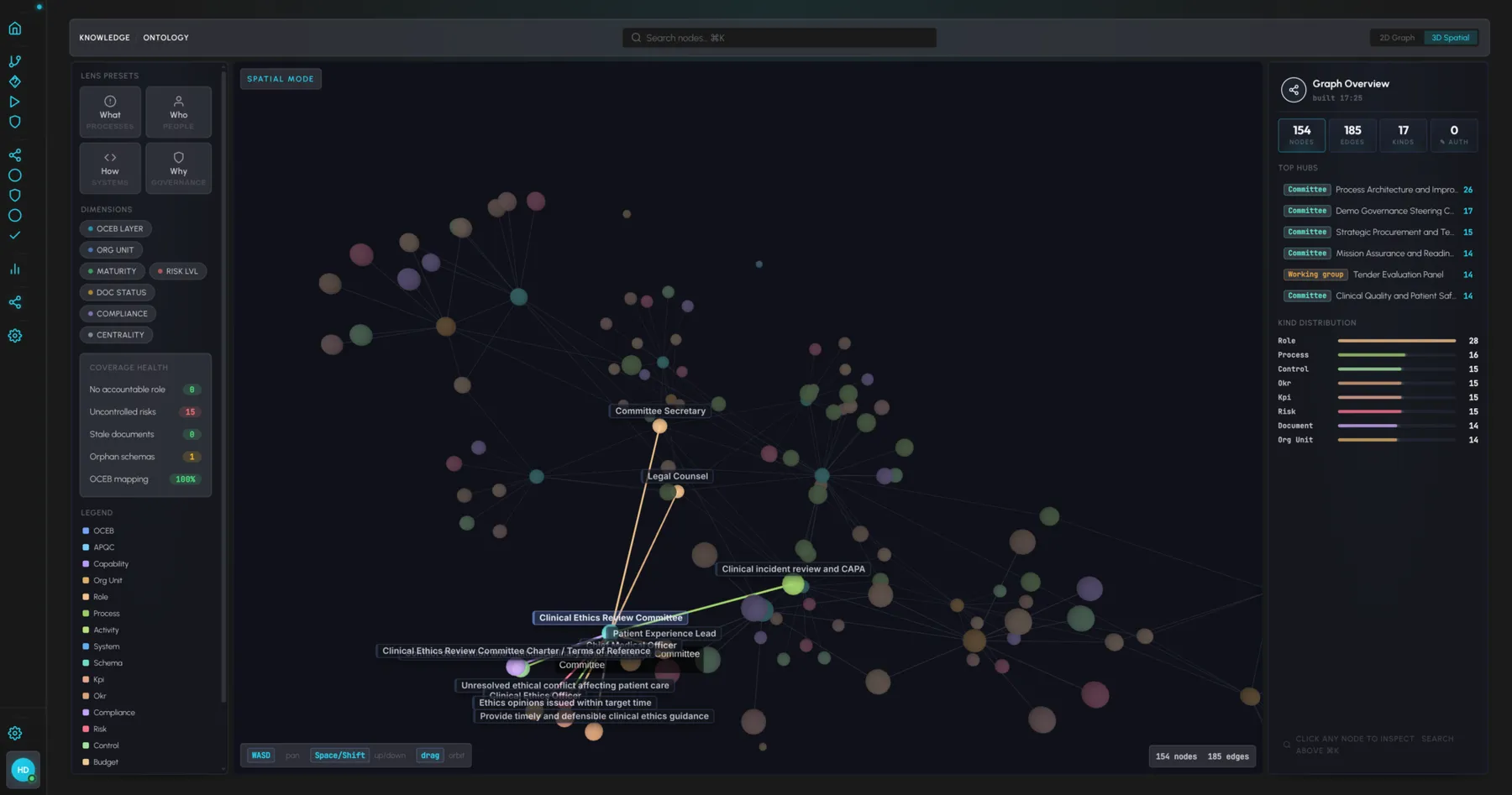
Ontology · the knowledge graph
A knowledge graph, not a Visio file.
Not a Confluence page. A queryable, versioned, governed model of what the business is — and how every part of it relates.
- Every capability, role, policy, KPI and regulatory obligation
- is a node — with typed relationships: owns, governs, measures, obliges.
- Line of sight in one query.
- From an ISO clause to the policy, the process, the role and the KPI that prove it — watch the path light up.
- Saved views.
- The CFO’s graph is not the auditor’s graph; each keeps their own lens on the same truth.
- Explore in 2D or 3D.
- A living force graph, not a static diagram — it moves when the organisation does.
helix · /ontology
3D spatial graph
Governance · the cockpit
From board policy to line-worker SOP — one chain of authority.
- RACI matrices
- per process — click to cycle a role, with conflicts flagged as you assign.
- APQC classification
- so every process has an address the industry recognises.
- Organisation tree and roles
- — the people in the model are the people in the building.
- Compliance gap matrix
- — which obligations have no process covering them, today.
- Evidence register
- — every claim of compliance points at the artefact that proves it.
OCEB line of sight
- L1BoardVision — why the organisation exists
- L2ExecutiveStrategy and OKRs that cascade
- L3GovernancePolicies mapped to obligations
- L4Process ownersProcesses modelled in BPMN
- L5ManagersProcedures, RACI and controls
- L6TeamsSOPs people actually follow
- L7FrontlineTasks — executed, owned, evidenced
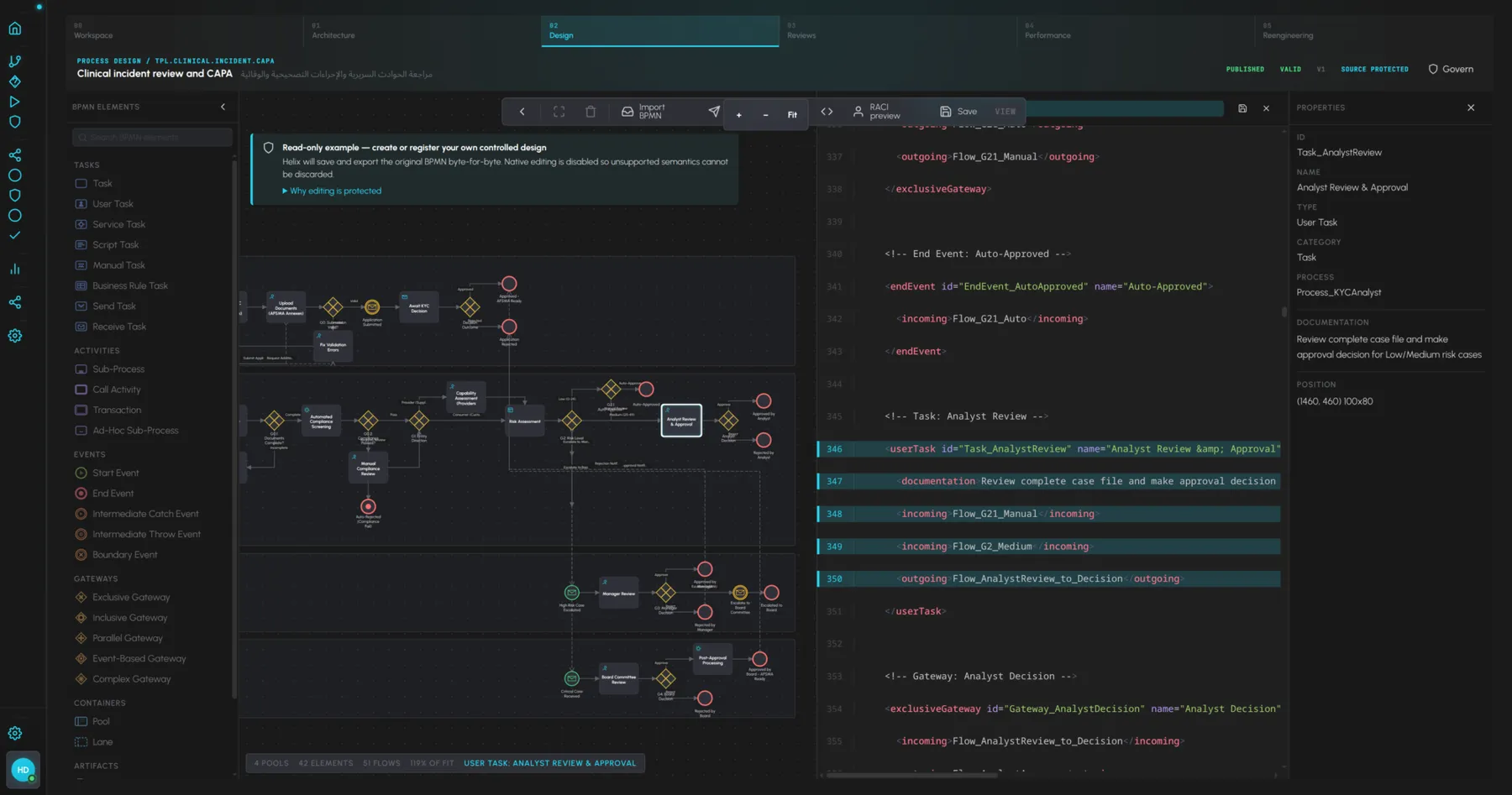
helix · /processes/design
BPMN 2.0 canvas
Processes · the studio
Draw it. Version it. Review it. Run it.
- BPMN 2.0 canvas
- — the notation your regulators, auditors and vendors already speak; standards-compliant XML in and out.
- Process architecture
- — the value chain above the diagrams, so every process knows where it sits.
- Templates and worked examples
- to start from something real, not a blank page.
- Governed reviews
- — a process is published by the role entitled to publish it, with the trail to prove it.
- Reengineering workspace
- — as-is beside to-be, with the delta in plain sight.
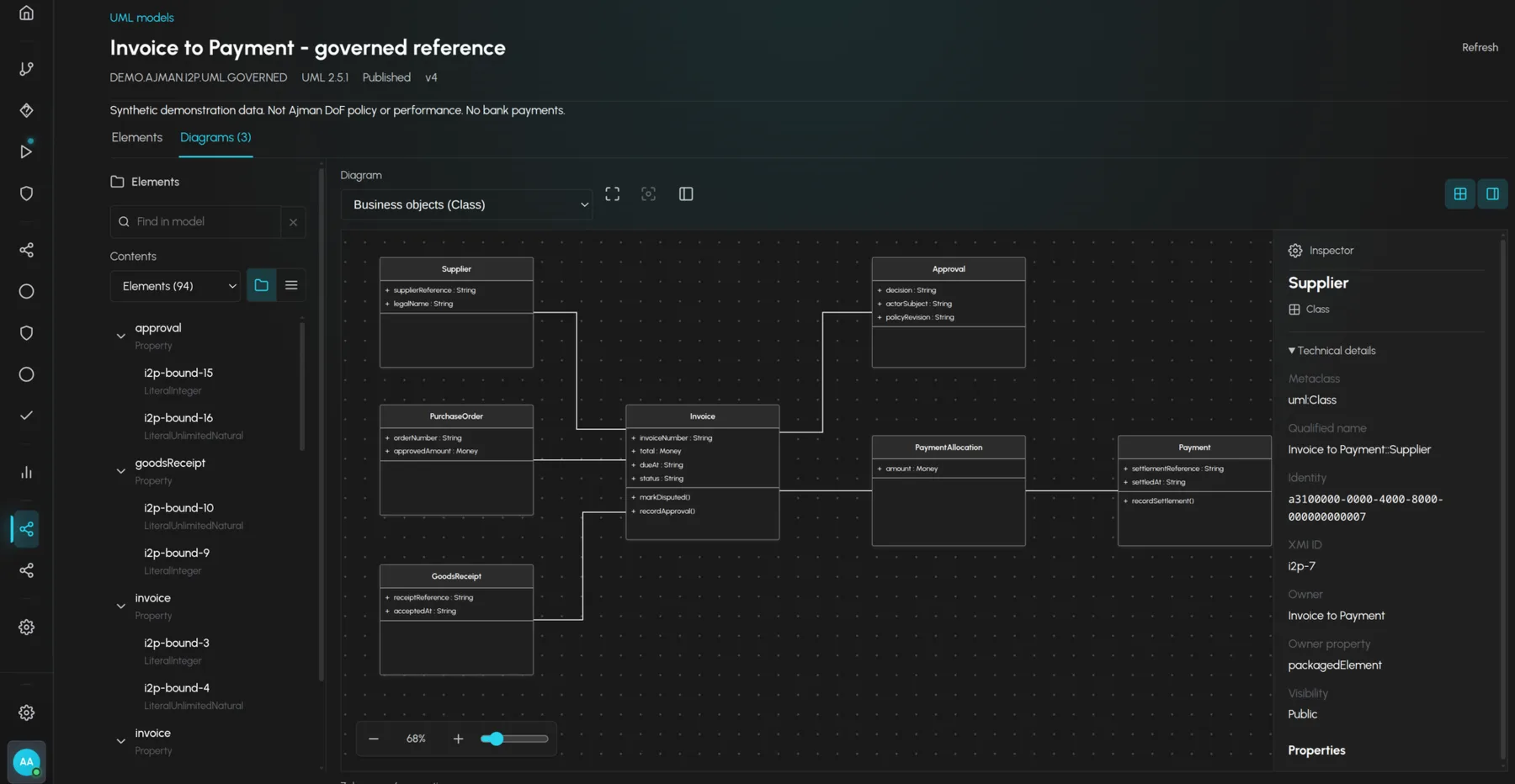
Models · UML
What exactly is an invoice?
Or an audit report, a purchase order, a test plan, a permit. Every business object the organisation handles, its structure and its lifecycle, defined once in UML 2.5 and referenced everywhere. The invoice is the example we carry through; the discipline is the same for all of them.
- The things and how they relate
- — supplier, purchase order, receipt, invoice, approval, payment. Does one payment settle several invoices? Can an invoice be partly paid? Answered once, for everyone.
- Lifecycles, stated precisely
- — Received, Matched, Disputed, Approved, Partially paid, Settled. BPMN describes the work; the state model says what the work changed.
- The systems that must cooperate
- — supplier portal, ERP, document repository, approval service, banking integration — as component and sequence diagrams, not a whiteboard photo.
- Published, versioned, referenced
- — a process, a decision, a policy or a control points at an exact published revision of the model. Change the model and its dependants know.
- UML 2.5 · fourteen diagram kinds
- XMI · model interchange
- OCL · constraints checked
helix · /uml
Modeling workbench
Execution · the engine
Every instance monitored. Every task owned.
The diagram you reviewed is the process that runs. No hand-off to a separate engine, no second model to keep in sync.
- Process instances
- you can open, inspect and trace step by step.
- A task inbox
- — every human step assigned to a person, with the context it needs.
- Governed decision bindings
- — a DMN decision fires inside the step that needs it, with the rule version recorded.
- Evidence captured as a by-product
- of doing the work — never as a chore afterwards.
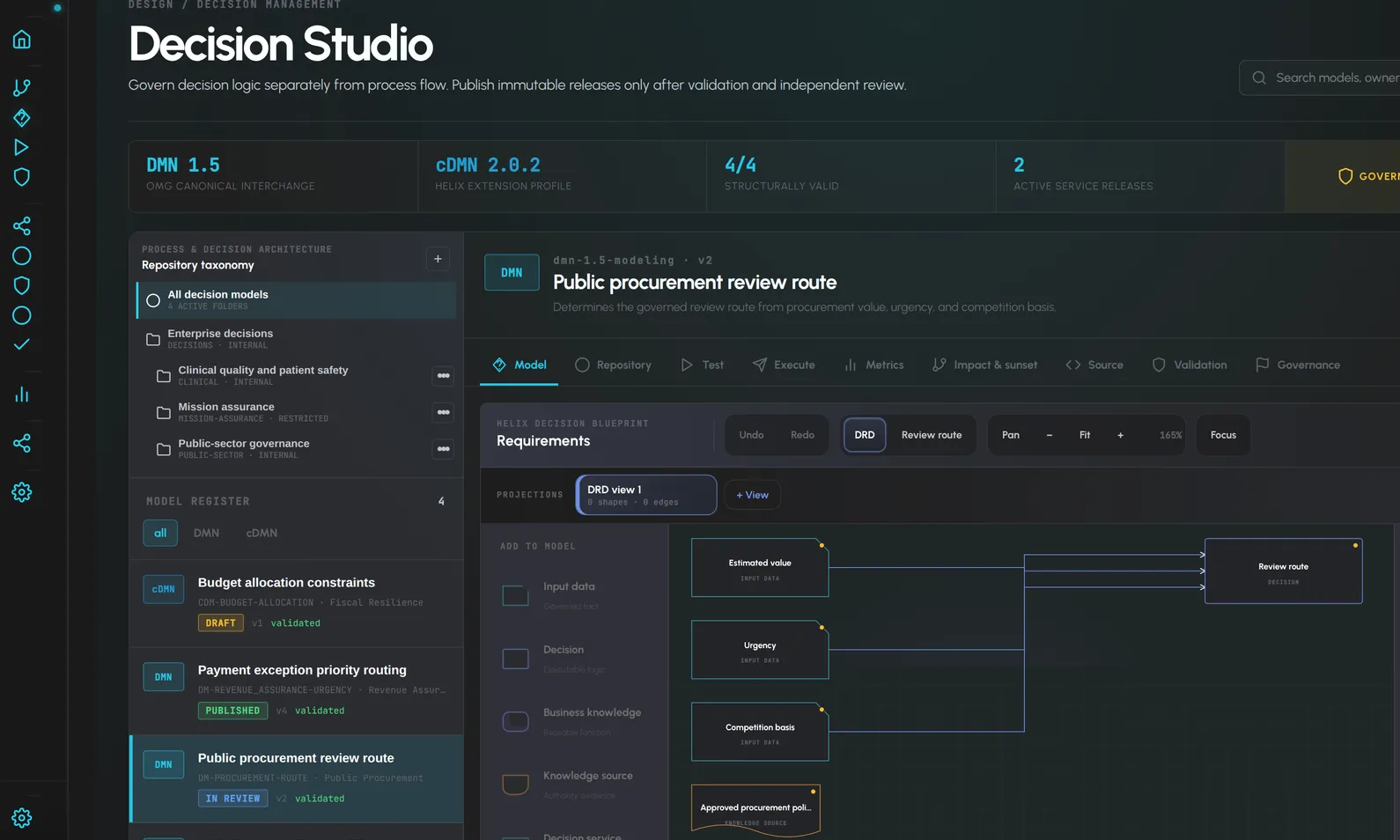
Decision management · DMN
Rules you can prove, not rules you remember.
- DMN and cDMN
- decision tables — authored natively, versioned like code.
- Conformance-tested
- against the OMG DMN technology compatibility kit, so your rules evaluate the way the standard says they should.
- Test assurance
- — expected versus actual on every rule, before publication.
- Simulation
- — replay a policy change against real cases and see who it touches.
- Bound to process
- — the decision lives in the step that needs it, with policy enforcement in the same breath.
helix · /decisions
DMN table + test assurance
- DMN TCK · conformance runner built in
- cDMN · constraint decisions
- Bindings · decision ↔ process step
Committees & working groups · in operation
A committee is a record, not a recurring invite.
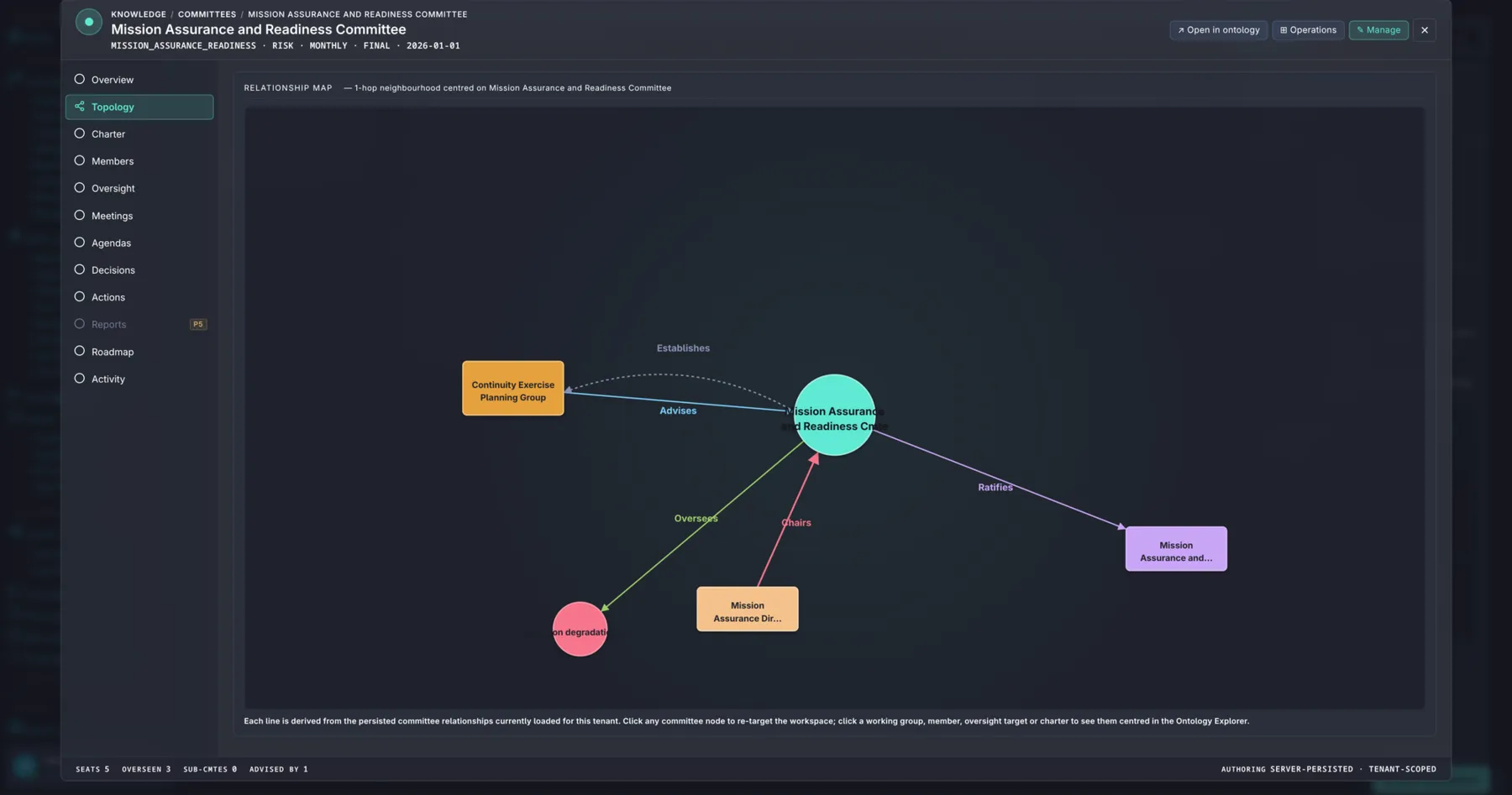
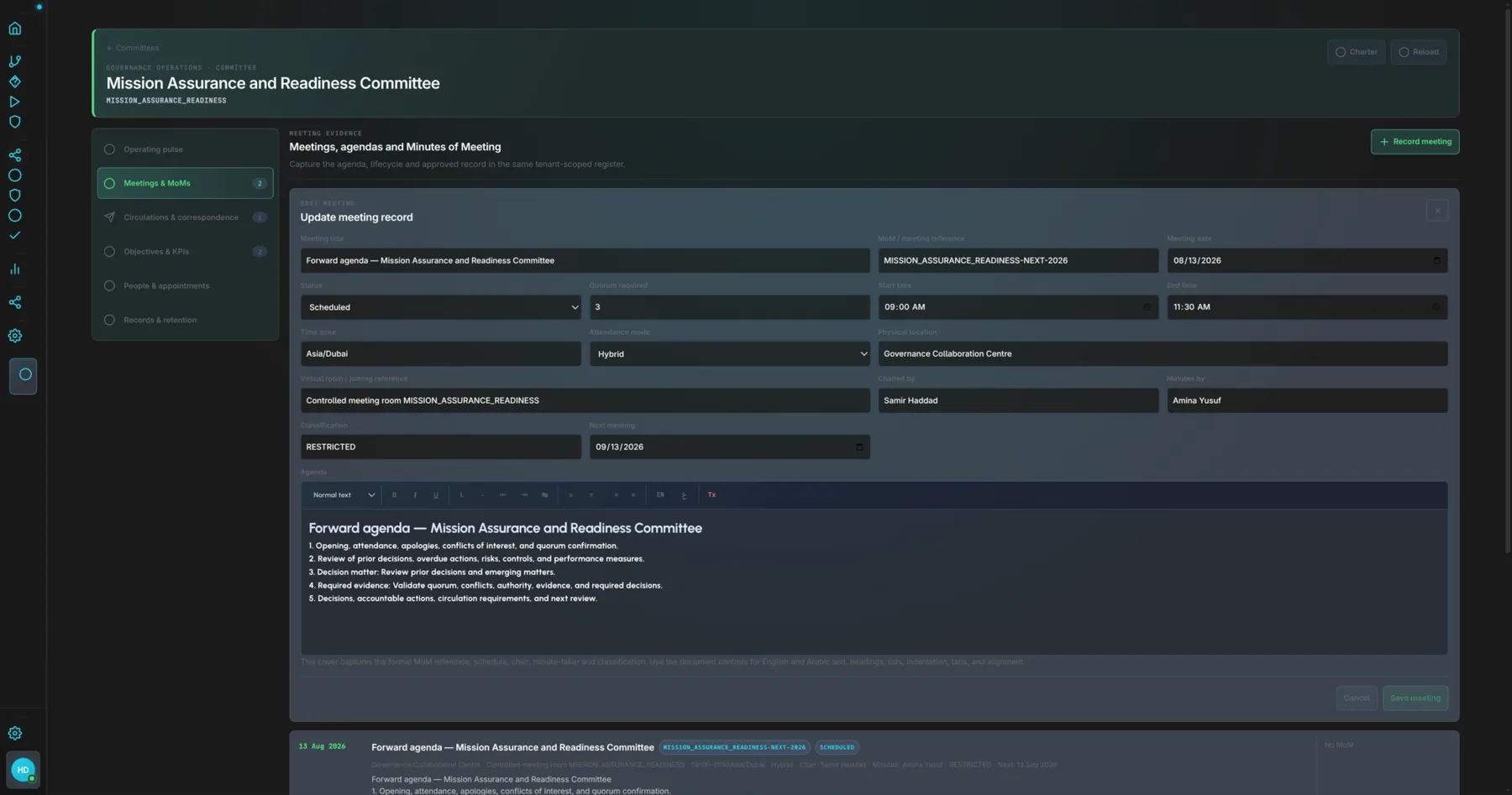
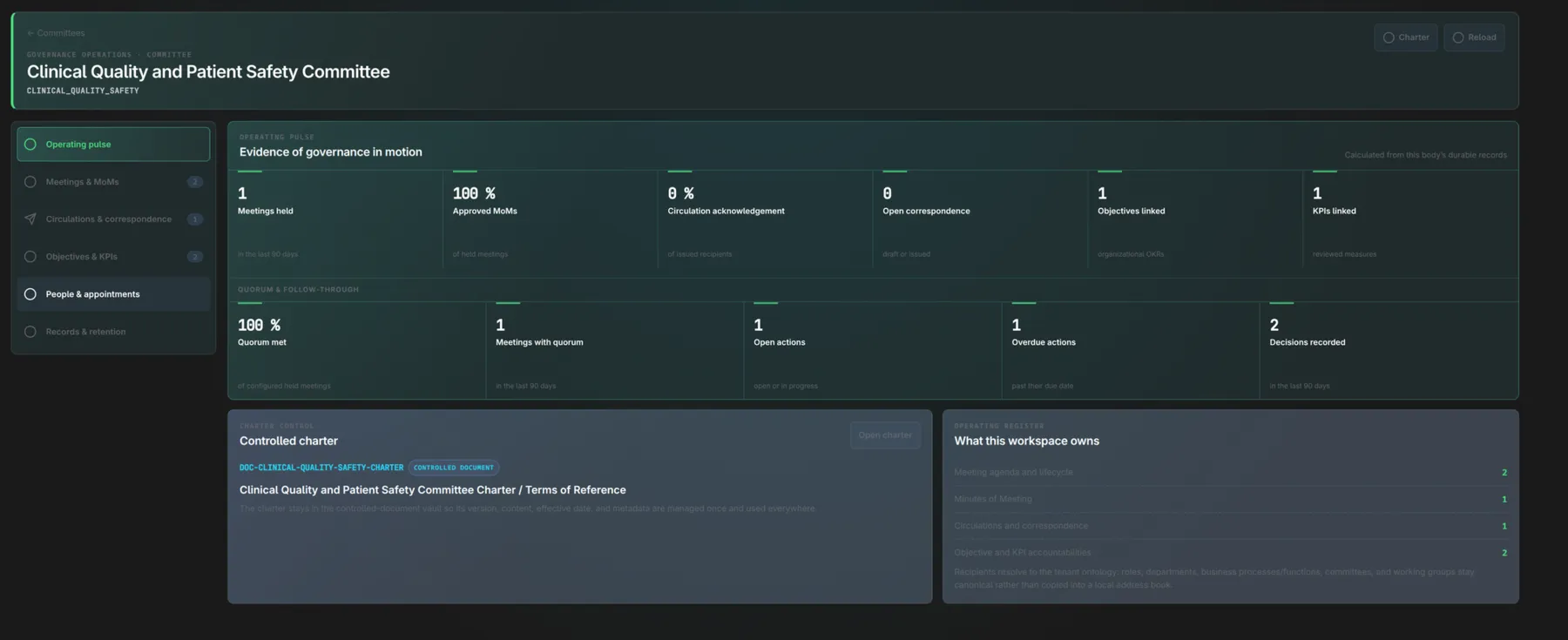
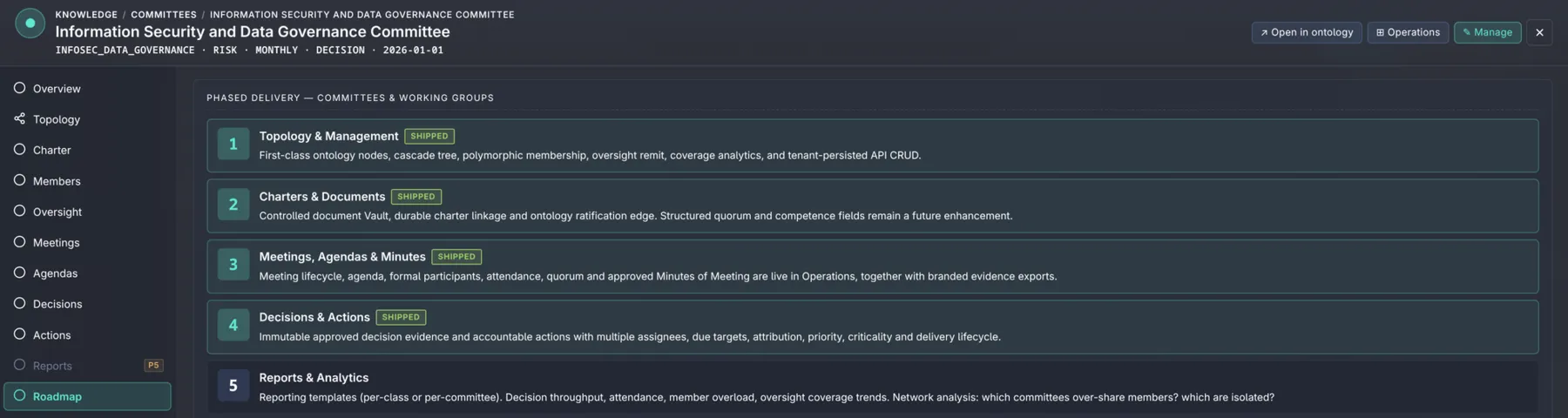
Boards, committees and working groups are the organs of governance — mandate, membership, quorum and term; agendas, minutes and resolutions. A resolution points at the policy or process it changes, so from any process you can see who authorised it, and from any resolution, what it moved.
helix · /committees/topology
Relationship map
helix · /committees/meetings
Meeting record
helix · /committees/pulse
Operating pulse
helix · /committees/roadmap
Delivery roadmap
Performance intelligence · metrics
When the process changes, the measurement follows.
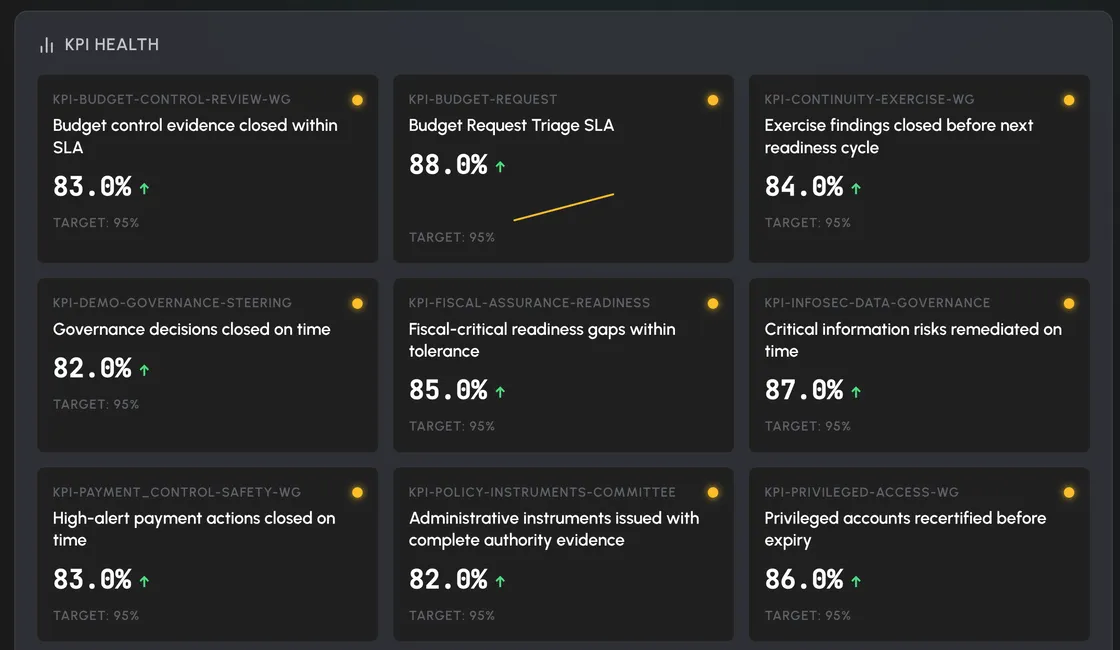
- KPI command center
- — gauges and sparklines bound to the processes that produce the numbers.
- OKR cascade
- — objectives from L2 to the team, key results with live progress.
- Budget versus actual
- with variance, per process and per unit.
- Coverage and maturity
- — which processes are modelled, executed, measured; how mature each one is.
- Anomalies surfaced by GENOME
- before the monthly review finds them.
helix · /metrics
KPI command center
Act II · where the value appears
Change how you operate — without losing control of what it touches.
A new approval policy lands. Because every definition is linked and versioned, the owner can:
01
Identify the impact
Affected decisions, processes, business objects, systems, roles and controls — one query on the graph.
02
Assess the proposal
Consistency checked; representative cases run through the new rules; simulated where the data supports it.
03
Coordinate the change
Owners assigned, revisions reviewed, integrations updated — and an explicit decision on cases already in flight.
04
Release a coherent set
Process, decision and data definitions versioned together. Never a new process against an old rule.
05
Measure the result
Turnaround, exceptions and rework tied to the versions that actually ran.
The executive sees whether the objective moved. The process owner sees where work stalls. The architect sees dependencies. The auditor sees the approved rules and the evidence. Nobody has to read UML — they need different views of the same connected truth.
Genome · native AI
The AI that reads your business's DNA.
Chatbots answer. GENOME acts — inside the same model, under the same permissions as the person who asked.
- Describe a process
- in plain language — get a valid BPMN 2.0 draft on the canvas.
- Predict the bottleneck
- before the SLA breaches, from your own execution history.
- Ask the organisation a question
- — "which processes touch a sanctioned counterparty?" — and get an answer from the graph.
- Permission-gated like its human
- , per-organisation model, cloud or on-premise.
Foresight · rehearse the change
Rehearse the change before you make it.
Most organisations discover the cost of a process change after it ships. Helix lets you find out first.
Simulation and case analysis are live today · process mining and orchestration arrive in the next release.
- Simulation live
- — run a proposed policy or decision against real cases; see throughput, cost and who gets caught.
- Case analysis live
- — open any case, compare it to its peers, find where the time went.
- Process mining next release
- — discover the as-is process from execution events, not from a workshop.
- BPEL orchestration next release
- — hand the service calls to the engine; people keep the decisions.
Every layer of the organisation · one model, six views
Everyone sees their own view of the same truth.
C-suite
Strategic Command Center
KPI heat-maps, OKR cascade, compliance posture — drill from vision to a single instance.
Governance
Policy Observatory
Policy-to-process traceability, the compliance gap radar, RACI across the organisation.
Directors
Tactical Operations
Department KPIs, budget versus actual, cross-unit process performance.
Analysts
Process Studio
BPMN canvas, APQC browser, version timeline, ontology explorer, simulation.
Managers
Procedure Hub
Procedure libraries, team RACI, task queues, improvement inbox.
Frontline
Mission Control
Task inbox, active instances, the SOP for this step — and nothing that isn’t theirs.
Under the hood · trust architecture
Built like infrastructure, because it is.
- Architecture
- Go services, hexagonal modules — one bounded context per business concern, twenty-five of them, each with its own domain, application and transport layers.
- Data
- PostgreSQL, versioned migrations, tenant-aware from the first table.
- Contract
- OpenAPI-first. A reviewed contract snapshot drives generated clients — the UI cannot drift from the API.
- Identity
- OIDC single sign-on with your identity provider; same-origin sessions and CSRF protection at the edge.
- Client
- Blazor WebAssembly, bilingual English / Arabic switcher out of the box.
- Deployment
- Container images — SaaS, or on-premise inside your perimeter, from the same build.
- Standards
- BPMN 2.0 · DMN (TCK-verified) · cDMN · UML 2.5 with XMI · OCEB layering · APQC classification.
Act IV · the next step
From first call to first process in weeks, not quarters.
- 0130 minutes
Discovery
Thirty minutes on the outcome you are chasing, the process it runs through and the obligation that hurts most.
- 02one session
Guided demo
A live walkthrough of Helix on a scenario shaped to your organisation.
- 03four weeks
Proof of concept
One outcome, one policy, one process — yours, modelled, executed and measured in Helix, with the impact of a change traced end to end.
- 04days to weeks
Deployment
SaaS provisioned in days; on-premise inside your perimeter in weeks.
Your organisation. Fully alive.
Fully modelled. Fully executable. One living model that runs, measures and evolves the business — bring us one outcome, one policy and one process, and we will stand it up on your numbers.
Built by nuroX · Mission-critical systems engineering